Talking Really Blog

Talk is NOT cheap, just plentiful

A man with severe learning difficulties should have a Covid-19 vaccine, despite his family's objections, a judge ruled.

Specialists said the man, who is in his 30s, was "clinically vulnerable" and in a "priority group" for vaccination.

But the man's parents objected and raised a number of concerns about alleged side-effects.

Judge Jonathan Butler agreed with NHS Tameside & Glossop Clinical Commissioning Group that vaccination was in his best interests.

The judge, who is based in Manchester, considered the case at a hearing in the Court of Protection, where issues relating to people who lack the mental capacity to make decisions are analyzed.

He did not name the man in his written ruling, published on Friday.

A number of specialists involved in the man's care all thought he should be vaccinated but his father claimed the vaccine had not been tested sufficiently and did not stop people contracting Covid-19.

He added the long-term side effects on people with severe health issues were unknown.

The man's mother and brother agreed.

Judge Butler said the man's father had outlined his concerns with "conviction and great clarity".

'No clinical base' He added: "I have no doubt whatsoever that his objections are founded on a love for (his son) and a wish to ensure that he comes to no harm.

"His objections were not intrinsically illogical. They were certainly not deliberately obstructive.

"They were made upon the basis as to what he regards as being in the best interests of (his son).

"That concern for his son does him credit."

But he said the family's objections had "no clinical evidence base".

He said the man was vulnerable and said there was "overwhelming objective evidence of the magnetic advantage of a vaccination".

The judge said he had ruled that vaccination was in the man's best interests, but had not authorized "physical intervention".

Health authority bosses had said the vaccine would not be administered if any "form of physical intervention" was required.

A Tameside and Glossop Clinical Commissioning Group spokesperson said: "Our primary concern will always be the best clinical interests of our patients and we work closely with patients, families, and clinicians, and care providers to understand any concerns or judgments made about their care."

Facebook page added

- Posted in General by

FACEACHE page completed... https://www.facebook.com/TalkingReallyUK ready for you to LIKE.

enter image description here

Website is done and dusted!

- Posted in General by

Well, finally the website is done, finished, finito, voila!

I'm never satisfied though, so tweaks and improvements will still happen as the weeks go on. Now, hopefully, people will join and we can, together, add information and links to help others. I said elsewhere, I would like this site to become the repository for all knowledge relating to disability issues, etc.

I am very happy with the outcome, the look, and design, the integrated member, blog and forum, which has been a week's worth of working, heartache and hair-pulling. If you write programs for websites or computers, you'll know how frustrating somethings can be, when you want one thing but the code won't allow it.

Sunday Live Stream (14th March 2021)

- Posted in Youtube Videos by

Here is Sunday's stream, in case you missed it. Including several phone in calls.

Rishi's Double blow to Disabled People

- Posted in News and Politics by

The chancellor has delivered a double blow to disabled people after refusing to extend a vital £20-a-week social security “uplift” to those on so-called legacy benefits and then failing to take any action to address the social care funding crisis.

In a budget speech of more than 6,300 words yesterday (Wednesday), Rishi Sunak did not mention disabled people, other than announcing he was extending existing funding for thalidomide survivors, and to announce £10 million to support armed forces veterans with mental health conditions.

But he failed to extend the uplift of £20 a week given to universal credit claimants at the start of the pandemic to those on “legacy” benefits such as employment and support allowance (see separate story).

This means that an estimated 1.9 million disabled people will continue to miss out on the £20-a-week payments.

Instead, Sunak (pictured) said he was extending the current uplift for six months and claimed in his speech that the government’s “response to coronavirus has been fair, with the poorest households benefiting the most from our interventions”.

Marsha de Cordova, Labour’s shadow women, and equalities secretary said it was “unbelievable that the chancellor has once again neglected disabled people’s financial support”, and she branded the decision “unacceptable discrimination”.

Dr. Rosa Morris, who has personal experience of the work capability assessment and has completed a Ph.D. examining the assessment process and disability benefits, suggested that work and pensions ministers were trying to use the uplift to force people onto universal credit.

She said on Twitter: “It’s an absolute lie that the poorest households have benefited most from the government’s COVID support.

“Those on legacy benefits still aren’t getting the £20 uplift and the government is now trying to use this to force those people to move onto universal credit.” Rishi Sunak The chancellor’s failure to act came as the government’s own social security advisers, the social security advisory committee, called in a new joint report with the Institute for Government, published the day before the budget, for the government to address this unfairness.

Stephen Timms, the Labour MP and chair of the Commons work and pensions select committee, also criticized the failure to help people on legacy benefits, including many disabled people and carers, who he said had received no additional support to help them through the pandemic.

He said: “In this budget, the government has once again ignored their needs.

“It cannot be acceptable that people are excluded from support simply because – through no fault of their own – they are claiming older benefits.”

There was also anger at Sunak’s speech failing to include any mention of social care, despite the pandemic further exposing the country’s worsening independent living crisis.

Fazilet Hadi, head of policy for Disability Rights UK, said: “With the National Disability Strategy soon to be published, it is seriously worrying that the government didn’t do anything to tackle the big issues facing disabled people such as poverty, lack of social care and barriers to employment.”

Labour leader Sir Keir Starmer said in his response to the budget: “Although the chancellor spoke for almost an hour, we heard nothing about a long-term plan to fix social care.

“The chancellor may have forgotten about it, but the Labour party never will.”

Last month’s health and social care white paper said the government would bring forward “proposals” later this year, but it has been making such pledges since promising that a social care green paper would be published by the end of 2017.

There was also no mention of social care in the main budget document.

The chancellor did announce a “lifetime commitment” to continue the thalidomide health grant in England beyond 2022-23 when the existing funding runs out.

This means, according to the budget document, an initial payment of £39 million for the first four years after the current grant runs out, with future funding then confirmed every four years “following an assessment of need”.

The funding pays for the cost of personalized support such as personal assistants, adaptations to homes and vehicles, and wheelchairs, for those with impairments caused by the drug being taken by their mothers during pregnancy between 1958 and 1961.

The funding is administered by the Thalidomide Trust, which also manages compensation paid by the firm that marketed thalidomide in the UK.

There are separate arrangements for thalidomide in Scotland, Wales, and Northern Ireland. There are more than 400 people in the UK who currently receive support.

Rowland Bareham, thalidomide sufferer, and chair of the trust’s National Advisory Council said earlier this week when the Treasury first announced the new funding: “I know that, like me, thalidomide survivors across England will be delighted and relieved that the government has guaranteed funding for their whole lives.

“Since it was introduced in 2010, the government health grant has made an enormous difference to the quality of our lives – helping us to manage our high levels of pain and maintain our mobility and independence without risking further damage.”

Disability News Service asked the Treasury why it had not extended the universal credit uplift to those on legacy benefits, and why the chancellor had failed to address the social care funding crisis in the budget, but it had not responded by noon today.

Meanwhile, outside the budget, regional growth minister Luke Hall announced today what he described as “a new £30 million fund” to increase the number of Changing Places facilities across England.

The funding will be used to install Changing Places toilets in existing buildings in England.

But Graham’s department later confirmed that this was the same Changing Places fund that was announced in last year’s budget, and again last July, when ministers agreed to change the law to ensure that all new large public buildings in England – such as shopping centers, sports stadiums, and cinema complexes – would have to include a Changing Places accessible toilet.

The disability charity Muscular Dystrophy UK was quoted in the press release from the Ministry of Housing, Communities and Local Government (MHCLG), and referred to “today’s announcement of £30m worth of funding” as “fantastic news for disabled people across England who need Changing Places toilets”.

The charity later admitted that it knew that the funding had been announced in last year’s budget, but it refused to explain why it failed to mention this in the MHCLG press release.

An MHCLG spokesperson said in a statement: “This is funding that the government originally announced in the March 2020 budget however due to COVID response and lockdown it was not possible to deliver it in 2020.”

Changing Places toilets include facilities with extra space and equipment such as hoists and changing benches for disabled people who cannot use standard accessible toilets.


Law Change allows Deaf Jurors

- Posted in News and Politics by

A leading Deaf campaigner has welcomed the government’s “long, long overdue” announcement that it will finally change the law to allow Deaf people who use British Sign Language (BSL) to serve on juries.

David Buxton (pictured) has spent a decade campaigning and lobbying ministers and other parliamentarians to persuade them to change the law.

Now the Ministry of Justice and the Home Office have announced that their new police, crime, sentencing, and courts bill includes measures that will allow profoundly deaf people to sit on juries in England and Wales for the first time.

The measure is part of a bill that ministers say will “crackdown on crime” and “keep our streets safe”, and which includes controversial measures on the right to protest, but which also includes measures they say will produce a “smarter, fairer justice system”.

One of those measures is to allow BSL-users to serve as jurors, after more than two decades of campaigning by Deaf people.

Common law rules currently ban the presence of a “stranger” in the jury deliberation room, but this will now be changed, with the bill introducing measures that will allow a BSL interpreter into the room.

Under the changes, interpreters will have to sign a confidentiality agreement that states their obligation to remain impartial and not pass on any discussions that take place in the jury room.

The Ministry of Justice said the change would open up jury service to more than 80,000 BSL-users across England and Wales.

Buxton, a former chief executive of the British Deaf Association (BDA) and now chief executive of the disabled people’s organization Action on Disability has been campaigning and lobbying ministers since 2011 to make the change in the law.

He said he was “very pleased” that the government was finally acting.

He was part of a Ministry of Justice working group that discussed the issue during the 2010 coalition government, which led to a promise to review the legislation after the 2015 election. David, deaf juror But no action had been taken by 2017 when Buxton himself was called up for jury service.
When he attended the court and said that he was Deaf and would be able to take part using a BSL interpreter, he was informed that he was not required.

He later launched a claim against the government for a judicial review of the ban, but he agreed to his legal action being put on hold after the Ministry of Justice said it would look into the matter further.

By the following year, no progress had been made, so he began lobbying parliamentarians and the government.

Jeff McWhinney, his predecessor as BDA chief executive, had himself been told by a crown court judge in 1999 that he could not serve as a juror because the law prevented him bringing an interpreter – a “13th person” – into the jury room.

The Labour government also said it was considering a change in the law at the time.

Buxton said this week: “It’s now 2021, and finally, a new day dawns with this change to common law enabling Deaf sign language users to be part of the justice system.

“This is long, long overdue but very welcome.”

He praised those who had supported the campaign, including his solicitor Louise Whitfield, as well as Professor Jemma Napier, Matthew Banks, and Linda Richards, and he also thanked justice secretary Robert Buckland.

But he stressed that the legal change was only “one more small step towards our goal of a British Sign Language Act in order to achieve true access and equality”.

Buckland said: “Disability should not be a barrier to people carrying out this most important civic duty.

“I am delighted we can open up jury service to many thousands more people and ensure our justice system becomes as accessible and inclusive as possible.”

Two disabled people have launched legal action against the Department for Work and Pensions (DWP) over its failure to offer recipients of so-called legacy benefits the same £20-a-week benefit increase given to those on universal credit.

They and hundreds of thousands of other disabled people were outraged when chancellor Rishi Sunak again failed to provide them with the same benefit “uplift” that was first handed to universal credit claimants at the start of the pandemic last March.

Instead, Sunak used last week’s budget to extend the uplift to those on universal credit for another six months.

This means that an estimated 1.9 million disabled people will continue to miss out on the £20-a-week payments.

The two campaigners have secured legal aid for their claim for judicial review of the failure to extend the uplift to those on the out-of-work disability benefit, employment, and support allowance (ESA).

They are arguing, through legal firm Osbornes Law, that the government’s decision has unlawfully discriminated against them as disabled people, under the European Convention on Human Rights.

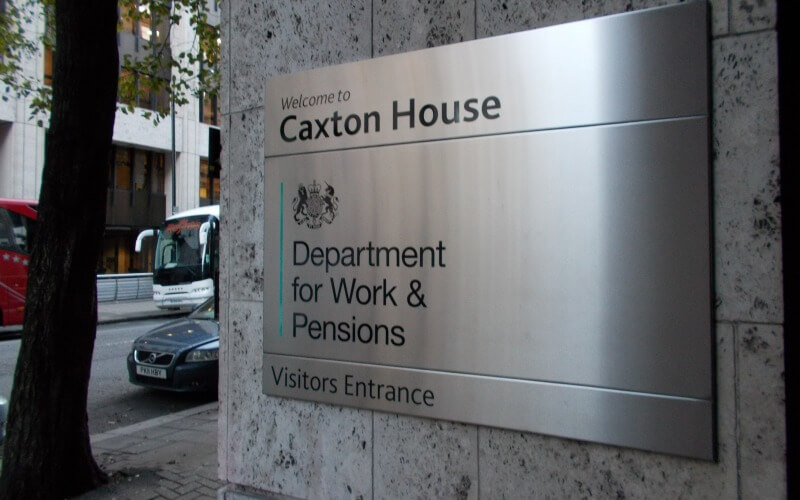
One of the two claimants has requested anonymity, but the other, Philip Wayland, from Essex, told Disability News Service (DNS) that he believes the failure to extend the uplift was “blatant discriminatory policy”. caxton house DWP He said: “Their claim is ‘we have put our arms around the most vulnerable people when they have categorically not done that.

“After 10 years of it, that is what pushed me into it, because I have had enough.

“It was an accumulation of the last 10 years, feeling as though we were being treated as second-class citizens, of years of feeling ignored and treated badly.”

He said he believed that the government was deliberately withholding the uplift from disabled people to try to force them to move onto universal credit and its stricter regime of conditions and sanctions.

Wayland, who has been receiving ESA for the last 10 years, is set to receive an annual inflation-linked increase of just 65p a week in his ESA next month.

Both the Commons work and pensions committee and DWP’s own social security advisory committee have called on DWP to extend the uplift to those on legacy benefits.

And last week, as part of its #More4All campaign, Disabled People Against Cuts delivered mailbags full of the testimonies of disabled people to DWP, the Treasury, and 10 Downing Street, describing the financial struggles they had faced during the pandemic.

Many of them wrote of their “soaring food costs”, including the extra costs of needing to have food delivered during the pandemic, and how they have “to choose between eating and heating”.

One said: “I would be able to bathe more and have my heating on. And be able to eat three times a day instead of two times.”

Another said simply: “On chemo… need to eat properly.”

Wayland said he was appalled when he heard Therese Coffey, the work and pensions secretary, tell an MP this week that she did not even ask Sunak to extend the uplift to those on legacy benefits.

Coffey told the SNP’s Marion Fellows to encourage people on legacy benefits to “go to independent benefits calculators to see whether they would automatically be better off under universal credit (UC)” rather than waiting to be moved across to UC by DWP in the next few years.

Early in the crisis, Coffey had argued that extending the uplift to those on legacy benefits like ESA and jobseeker’s allowance would risk the “safety and the stability of the benefits system”.

Only last week, DNS reported how it was branded “vexatious” by DWP for trying to secure a key unpublished document that could finally show how many disabled people are expected to lose out in the move to universal credit.

The most recent DWP equality impact assessment, published nearly a decade ago, in November 2011, suggested that the number of disabled households gaining financially from universal credit would be at least matched by the number losing out (with about 800,000 households in each group), with disabled people who are out of work particularly likely to lose out.

By noon today (Thursday), the Treasury had still not been able to explain last week’s decision not to extend the uplift to those on legacy benefits.

A DWP spokesperson said the department could not comment on ongoing legal proceedings, but he pointed to the comments made by Coffey on Monday, and similar comments by fellow DWP minister Will Quince, who said the uplift had been introduced “to support those facing the most financial disruption due to the pandemic”.